Published

Of the patients meeting criteria of drug-related hepatic disorders, 528 were from post-marketing sources and 36 from trials after the SKYLIGHT program.

  • More than 270,000 patients have been treated with fezolinetant worldwide since it was available in May 2023.1 
  • Limitations of assessing post-marketing data include missing information (e.g. laboratory values, medical history), lack of follow-up, potential contributing factors not reported (e.g. comorbidities, concomitant medication), continually changing data and potential underreporting.1 
  • As of November 2025, a total of 564 cases meeting the search criteria of drug-related hepatic disorders were retrieved cumulatively from the Astellas Global Safety Database; 528 cases were reported from post-marketing sources and 36 cases occurred in clinical trials after the SKYLIGHT program.1 
  • Of the reported cases, 84.2% (475/564) were non-serious, with reported events being non-serious or ALT/AST elevations < 3 x ULN or included qualitative statements about liver enzyme elevations without reporting laboratory values, and 15.8% (89/564) were serious based on events of interest.1 
  • In 6.1% (24/391) of cases additional signs or symptoms of hepatotoxicity were reported, although the timing relative to liver test abnormalities was unclear due to limited information.1
  • In 4% (7/173) of reported cases, patients had concurrent increases in transaminases (> 3 x ULN) and bilirubin (> 2 x ULN).1 
  • Drug-induced liver injury (DILI): there is no universal definition of DILI. The International DILI Expert Working Group definition2 has been used for measuring DILI in the pharmacovigilance setting. Once other causes of liver injury have been excluded, DILI is defined as any of the following:
    • ALT ≥ 5 × ULN OR
    • ALT ≥ 3 × ULN, and TBIL > 2 × ULN, and no / minimal elevations in ALP OR
    • ALP ≥ 2 × ULN when the source of increased ALP levels is the liver.
  • The severity of DILI is further defined according to the presence or absence of clinical signs and symptoms.
  • Overall, when laboratory details were reported, analysis revealed that 32 out of the 89 serious cases met the definition of DILI.1 
    • A committee of hepatology experts theorize that DILI of fezolinetant may be an idiosyncratic type which is a rare, unpredictable liver reaction that occurs in a small number of people, independent of dose.1 It is often delayed in onset and driven by individual factors such as genetics, adaptive immune response with or without other factors such as mitochondrial stress. Diagnosis is by exclusion, and treatment involves stopping the drug and monitoring liver function.

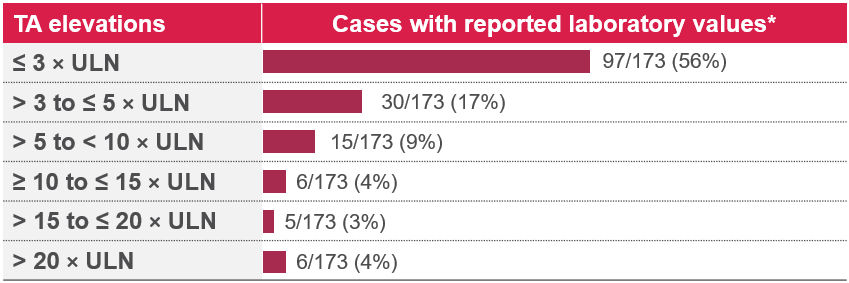
  • Of the 173 cases with specific laboratory values, peak TA elevations included: >20x ULN in 3.5% (6/173) cases, >15-20x ULN in 2.9% (5/173) cases, >10-15 x ULN in 3.5% (6/173) cases, >5-10 x ULN in 8.7% (15/173) cases and >3-5x ULN in 17.3% (30/173) cases.1

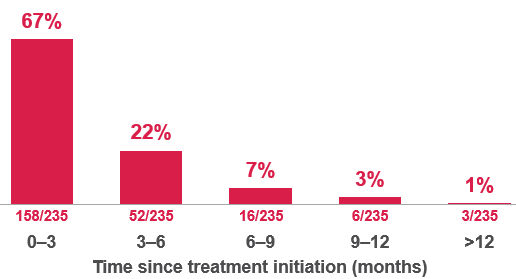
Table 1. Reported time to first detection in 235/564 cases1

Effect of discontinuation1

  • In 65.1% (367/564) of cases, information about action taken was reported.
  • Fezolinetant was discontinued in 280/564 cases, dose interrupted in three cases and dose decreased in two cases. Among these 285 cases, the event outcome was reported as resolved/resolving in 33.7% (96/285) of cases (a positive de-challenge).

  1. Data on file.

  2. Drug-induced Liver Injury (DILI): Current status and future directions for drug development and the post-market setting. A consensus by a CIOMS Working Group. Council for International Organizations of Medical Sciences (CIOMS). Available at: https://cioms.ch/wp-content/uploads/2020/06/CIOMS_DILI_Web_16Jun2020.pdf.

find-my-msl

Find My MSL

Medical Science Liaisons are available to help answer your scientific questions.

submit

Submit an Inquiry

For any medical inquiries, please submit your question online to Astellas Medical Information or call or fax your inquiry.

Astellas Phone: 1-800-727-7003

Fax: 1-877-829-7942

adverse

Report an Adverse Event or Product Complaint

Report adverse events and product complaints to Astellas or FDA MedWatch.

Astellas Phone: 1-800-727-7003

FDA MedWatch: 1-800-FDA-1088

Hours: M–F, 8 AM–4:30 PM (CT)