This site is intended for US healthcare professionals


In Year 2 of the GATHER2 trial, treatment with ACP 2 mg every other month significantly reduced GA growth with no new safety signals identified.
EOM efficacy results
Figure 1. GA growth over time at Year 2 using a slope analysis (re-randomized analysis set)2
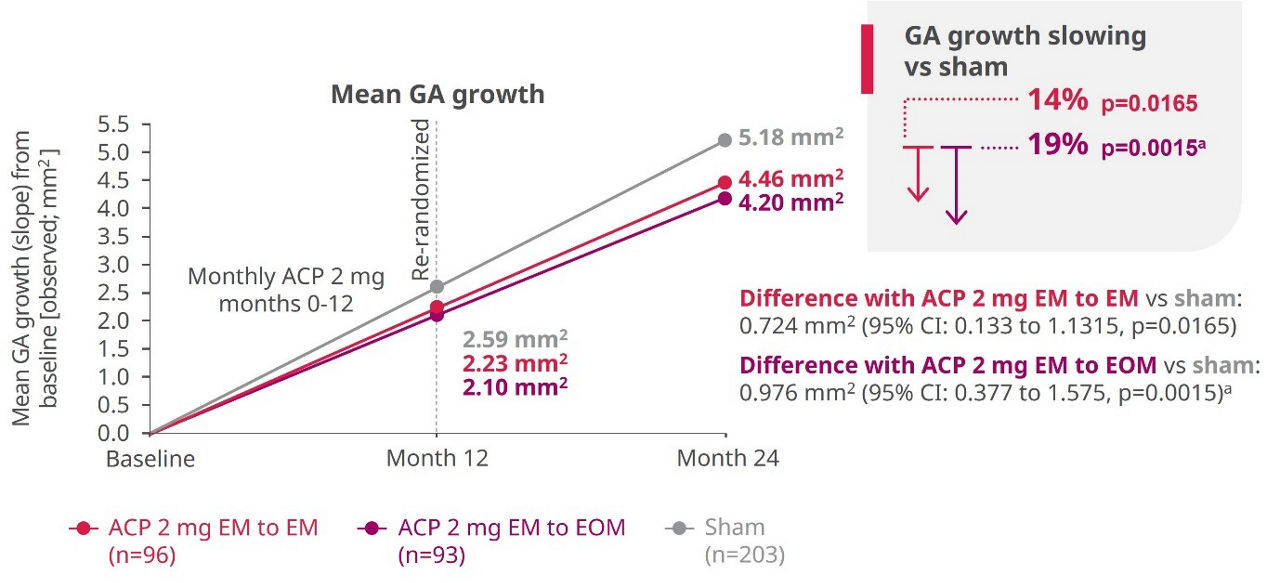
ap-value is nominal. Note: This analysis is based on a mixed model assuming constant growth rate from baseline to Year 2. The ACP 2 mg EOM group received monthly ACP 2 mg in the first year (ACP 2 mg EM to EOM).
Adapted from: Khanani AM et al., Ophthalmology 2025.
Figure 2. Change in GA growth (piecewise analysis)2
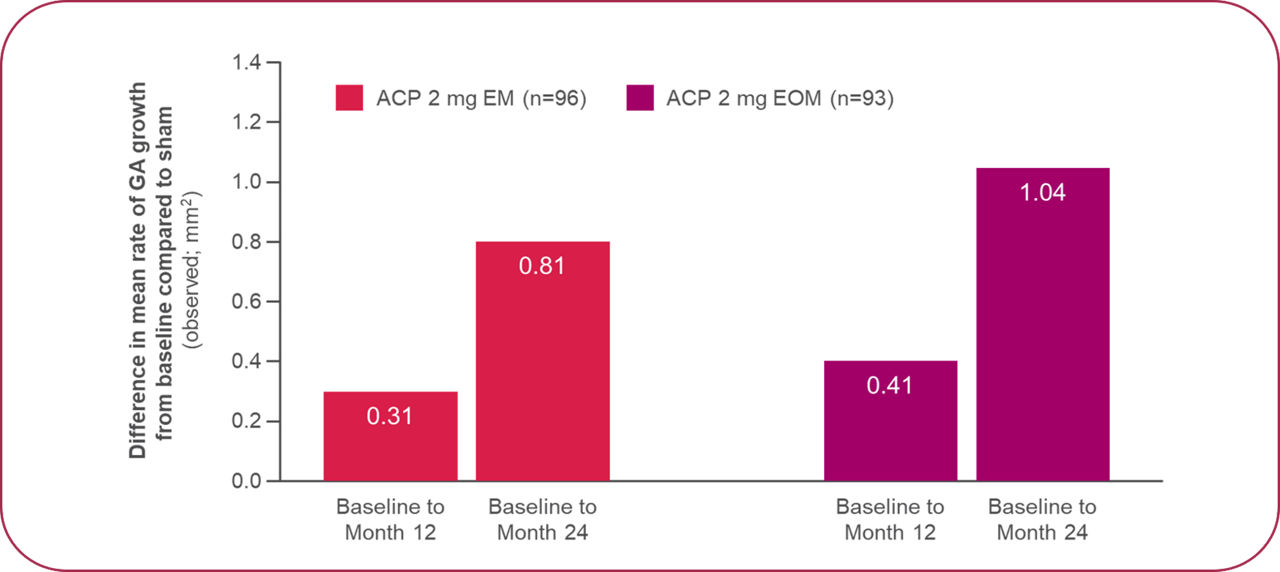
Note: This is a simplified piecewise slope spline multivariate and repeated measures analysis.
This analysis is based on a mixed effects model for repeated measures assuming a piecewise linear growth slope every six months. The model included effects for treatment, time, and time-by-treatment interaction.
The ACP 2 mg EOM group received monthly ACP 2 mg in the first year (ACP 2 mg EM to EOM).
Adapted from: Khanani AM et al., Ophthalmology 2025.
Subgroup analysis2
Figure 3. GA growth rate by demographics and clinical characteristic subgroups2
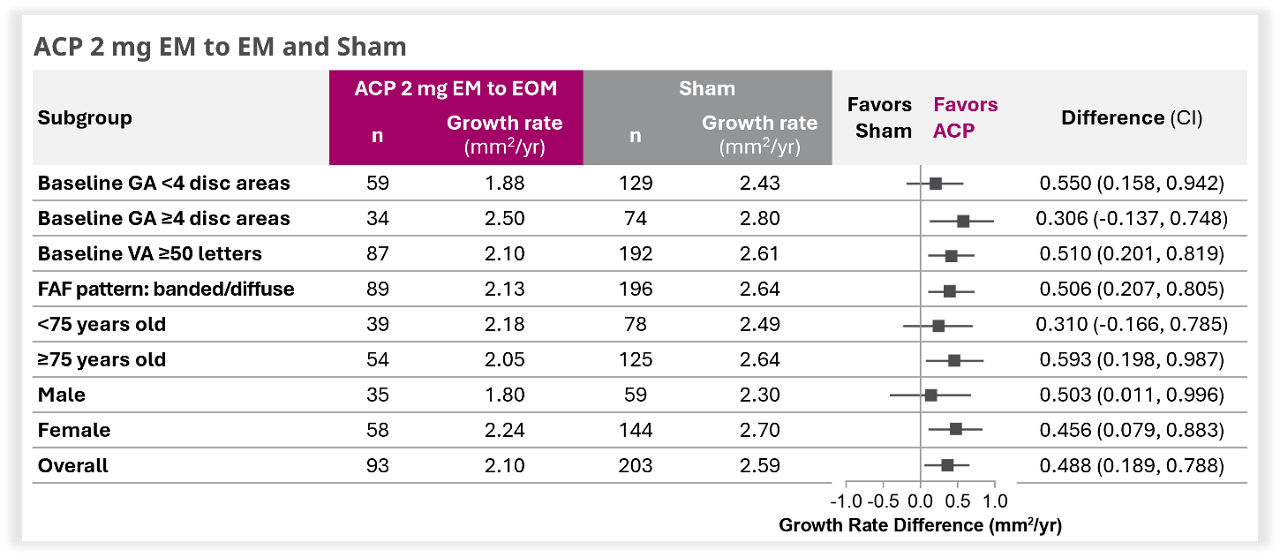
The ACP 2 mg EOM group received monthly ACP 2 mg in the first year (ACP 2 mg EM to EOM).
Adapted from: Khanani AM et al., Ophthalmology 2025.
EOM safety results
Table 1. Summary of serious ocular TEAEs and AEs of special interest2
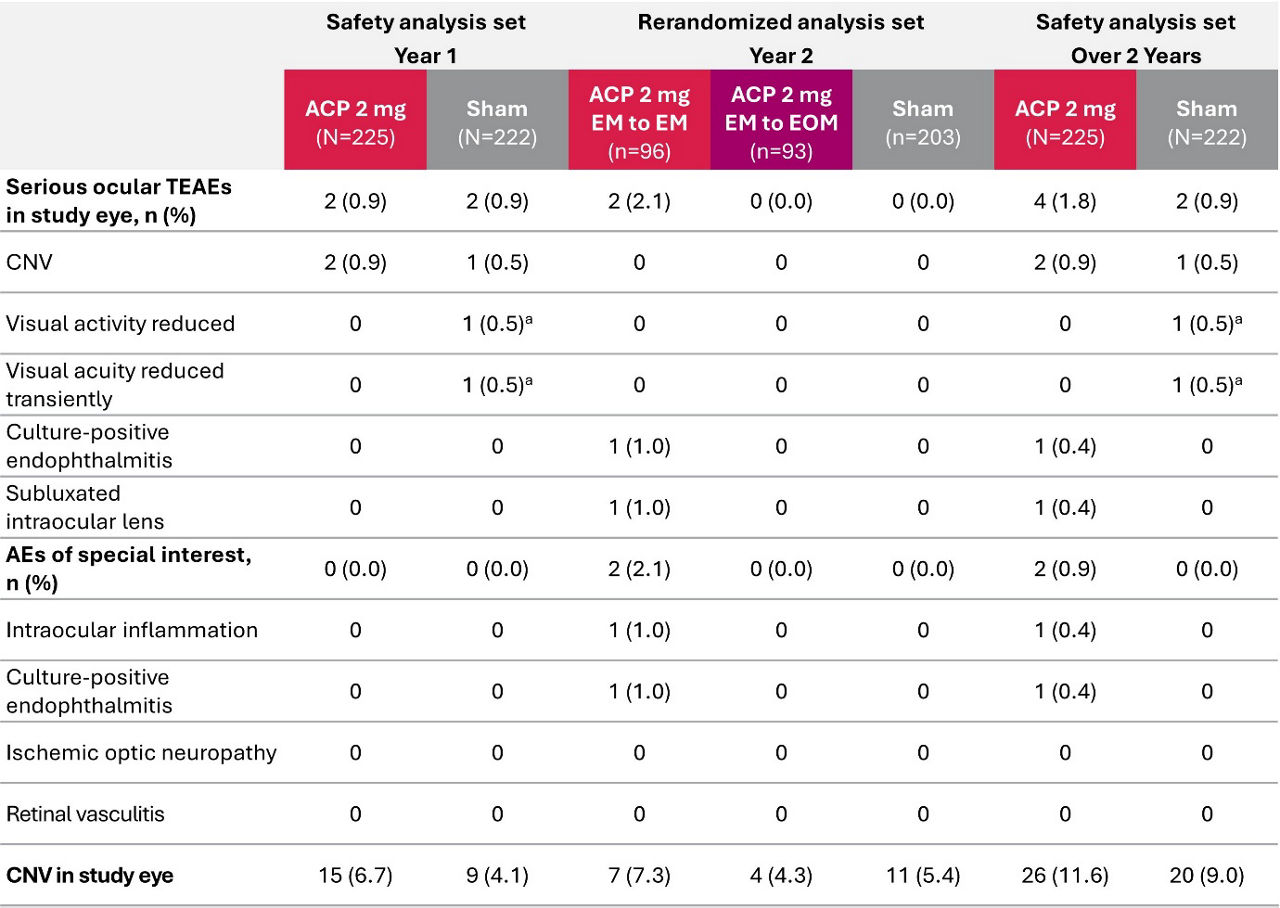
Adapted from: Khanani AM et al., Ophthalmology 2025.
Khanani AM, Patel SS, Staurenghi G, et al. Efficacy and safety of avacincaptad pegol in patients with geographic atrophy (GATHER2): 12-month results from a randomised, double-masked, phase 3 trial. Lancet. 2023;402(10411):1449-1458. Available at: https://doi.org/10.1016/s0140-6736(23)01583-0.
Khanani AM, Danzig CJ, Heier JS, et al. Avacincaptad pegol for geographic atrophy secondary to age-related macular degeneration: 2-year efficacy and safety results from the GATHER2 phase 3 trial. Ophthalmology. 2025;epub ahead of print. Available at: https://doi.org/10.1016/j.ophtha.2025.12.011.
If you are not able to find the information through the Search function, please contact our Medical Communications and Engagement Department by using any of the channels below:
The medical information on this website is for educational purposes only and is intended to provide scientific information about Astellas products. This information is not intended as medical advice or clinical recommendations. This website is for use only by United States residents and licensed healthcare professionals (HCPs) practicing in the United States. Product labeling may vary between countries.
Please choose an option that best describes you:
For visitors outside the United States: click here


